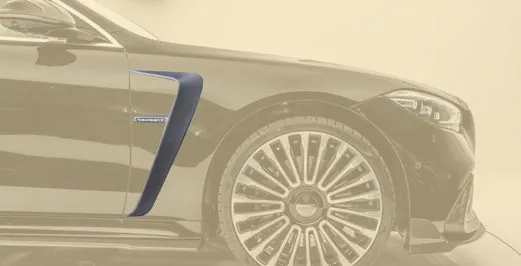
Air outtake for front fender Mansory for Mercedes-AMG S63E


Mansory Air Outtake for Front Fender for Mercedes-AMG S63E
Among the three fender-vent treatments in the Mansory programme for the S 63 E PERFORMANCE, this air outtake occupies a deliberately middle position: it carries fewer slats and a shallower outer depth than the deeper sport variant, but more carbon presence than the soft variant. Specified by owners who prize a flagship saloon's restraint over a coachbuilt's emphasis, it lets the W223's long-wheelbase fender shoulder retain its OEM-derived line while still introducing a meaningful carbon plane and a useful pressure-bleed for the front wheel-arch volume. With the AMG biturbo V8 PHEV powertrain pushing 802 hp / 1430 Nm through a 9-speed AMG Speedshift MCT and 4MATIC+ AWD into the saloon's 2,510 kg kerb mass, the front-arch volume sees a real radiated heat load from the hot V8 exhaust manifolds and AMG-specification brake rotors; the air outtake gives that load a sideways escape with a controlled, OEM-aware visual signature. It belongs in the parent Mansory Carbon Fiber Body kit set for Mercedes-AMG S63E.
Construction & Materials
Compared with the deeper sport variant, this part trades slat depth for cleaner outer-skin run, which means the layup is biased toward outer cosmetic stiffness rather than internal slat structural mass. The carbon stack therefore differs in subtle ways from its sibling.
- Cosmetic outer face: 2K plain weave (default) — finer grain than the sport variant's 3K twill
- 3K twill, forged-look options available for owners who specify a busier outer grain
- Slat module: pressed-and-cured carbon ribbon, six slats per side, set into the perimeter frame
- Bake schedule: ramp-and-soak autoclave cycle, 130 °C peak, with a longer dwell at 80 °C
- Outer wall 1.6–1.9 mm; perimeter wall 2.8–3.4 mm
- Mass per side: 0.32–0.45 kg dry — among the lighter pieces in the front-side programme
- OEM stud retention: stainless threaded receivers, M6, factory-pattern
- Edge sealing: 3M VHB 5952 inner return; transferable OEM rubber gasket
Design & Visual Function
The geometry brief is to add carbon presence on the side of the saloon without abandoning the OEM-derived fender shoulder. The slat trailing edges are profiled with a 1.5 mm radius which prevents the Aeolian-tone whistling that an undertuned louvre can produce at certain road speeds; that radius and the shallower slat depth together make this the quieter and more cabin-friendly of the louvre variants. From normal viewing distance the panel reads as a refined OEM accessory; only at close range do the individual slats resolve and reveal carbon depth.
The slat angle is set roughly 14° from the local body surface — shallower than the sport variant's 18° — directing bled air more horizontally into the side surface's upper boundary layer. The functional consequence is a smaller boundary-layer disturbance and a less aggressive shed pattern, which is consistent with the part's overall register: present but not declarative. With a 4MATIC+ AWD chassis loading the front axle harder than a comfort-line W223, the wheel-arch column is a real thermal target, and even the more conservative pressure delta this variant supplies is enough to lower brake-rotor soak after a hard pull.
Owners who specify body-colour wraps over the OEM AMG paint sometimes paint the perimeter frame to match the body and leave only the slat depth as carbon, which is a coherent option on this part because the frame area is larger than on the sport variant. A primer-finish supply is available specifically for this conversion path.
Compatibility & Fitment
Engineered for Mercedes-AMG S 63 E PERFORMANCE (W223), 2023+, saloon. Mirror-image left/right pair. Compatible with AMG Night Package and AMG Carbon Package specifications. The mounting datums are the OEM AMG fender-skeleton M6 receivers; the OEM rubber gasket transfers from the donor vent to the carbon panel during installation. Factory 20" and 21" AMG wheels clear the louvre interior; the slats themselves sit roughly 25–30 mm clear of the front shock tower's lateral travel envelope. AIRMATIC ride-height behaviour is irrelevant since the part lives on the upper fender plane. Cars optioned with AMG Carbon Ceramic Brakes will see a small thermal benefit at the front rotor by virtue of the steadier wheel-arch pressure field.
Installation & Reversibility
Allow 25–40 minutes per side; the bumper does not need to come off. The technician releases the OEM AMG vent (factory clip pattern), inspects the rubber gasket for compression-set, transfers the gasket if serviceable or swaps it for a fresh service item if not, primes the bond pad area with 3M Cleaner-Primer 94, dry-fits the carbon panel against the fender-skeleton M6 receivers, mates and torques the fasteners to 8 Nm, then sets the upper VHB seam home with a soft rubber roller. A 24-hour cure period is required before exposing the panel to a high-pressure wash. Removal for a return-to-OEM is non-destructive: the OEM vent reseats on its original clips, the bumper and fender are unmodified, and the M6 receivers are unaffected by the bond cycle.
Pairing within the Mansory Mercedes-AMG S63E programme
Combined naturally with the Front bonnet directly forward (their carbon planes share the same upper-body palette), with the Engine cover so the under-hood view continues the carbon palette into the engine bay, and with the Mirror 1 housing LHD for visual continuity at the door shoulder.
Maintenance & Durability
Cleaning is straightforward — fewer and shallower slats trap less brake-dust than the sport variant. A light hand-wash routine with pH-neutral shampoo and a plush noodle mitt is enough; technicians sometimes follow with a low-pressure rinse from the inside of the wheel arch to flush whatever fines settled between the slats. Acid-based wheel cleaners are the principal threat — they drift on the wash mist and dwell in the slat shadow if not rinsed promptly, and they will haze the lacquer there before any other surface on the car. A semi-annual ceramic spray sealant on the slats and perimeter keeps the lacquer's hydrophobic life topped up. Stone strikes on the perimeter leading edge should be sealed with a clear UV epoxy within seven days; deeper laminate damage refers to a carbon repair specialist rather than a body shop. Cosmetic-finish lifespan: roughly 9–12 years with regular care, a little more if the car lives garaged.
Lead Time & Warranty
Production turnaround: 3–5 weeks from order confirmation. Custom finish requests (matte, satin, forged-look) extend the cycle by roughly one week because the topcoat ramp differs from the standard high-gloss schedule. Coverage: the standard 12-month warranty against manufacturing defects — delamination, voids, fitment shortfalls, slat-bond integrity, and clear blistering — runs from delivery date. Outside that scope are kerb damage, stone chip propagation, and chemical staining from acid-based cleaners. Each pair ships in a foam-lined carton with the OEM-pattern stainless inserts in a sealed bag and the QC photograph documenting slat-edge alignment under raking light.
FAQ
Q: How does this air variant relate to the soft and sport variants?
A: Three points on a spectrum — soft sits closest to the OEM aesthetic, sport is the most emphatic, and air sits in between. Owners who want carbon character without changing the OEM-derived fender register usually choose the air variant.
Q: Is the part identical for LHD and RHD cars?
A: Yes — the same SKU fits both, with mirror-image left and right pieces.
Q: Can the panel be repainted body-colour at a body shop?
A: Yes, specify the primer-finish supply. The carbon weave does not show through the colour coat once the local body shop has built primer to opacity. Mask the bond pad before paint to keep the VHB adhesion intact.
Q: How big is the cooling benefit on a hot-day track day?
A: Modest by design. The pressure-bleed area is ~1.7× the OEM vent rather than the sport variant's ~2.5×, so the brake-rotor soak reduction is real but not dramatic. Owners who track the car heavily often combine this with the front bonnet's vent geometry for a stronger overall extraction effect.
Q: Does the louvre cause cabin noise on the autobahn?
A: No. The slat trailing-edge radius is set specifically to suppress Aeolian tones in the typical road-speed band; OEM glazing and door seals continue to dominate cabin NVH.
Q: Does the louvre interfere with the AMG Active Multibeam LED headlight or front parking-sensor cluster?
A: No. The fender vent is well aft of both with no overlap of the lighting projection cone or the parking-sensor field.
Pair the air outtake with the front bonnet and the door-shoulder mirror trim to keep the upper-body carbon palette consistent across the saloon's longest visible plane. To configure your build, message WhatsApp +44 7488 818 747 or write to [email protected].